

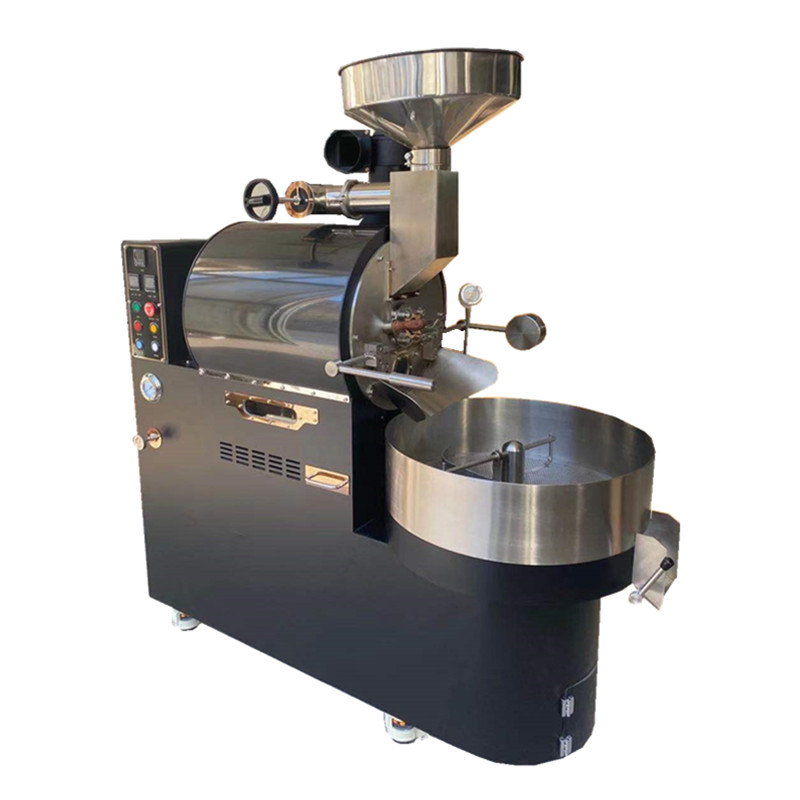
Vibration Dynamics in Coffee Roasting Machines: Mechanisms, Impacts, and Optimization
Understanding the Role of Vibration in Coffee Roasting
Vibration is an intrinsic yet often overlooked component of coffee roasting machinery. It influences heat distribution, agitation efficiency, and even the final flavor profile of roasted beans. During the roasting process, the drum or chamber’s rotational motion generates vibrations that help prevent coffee beans from clumping or burning. This agitation ensures uniform exposure to heat, which is critical for achieving consistent roast levels across batches.
The intensity and frequency of vibrations vary based on the roaster’s design. For example, drum-style roasters rely on mechanical rotation to create vibrations, while fluid-bed roasters use hot air currents to suspend beans, generating less mechanical vibration but requiring precise airflow control. In hybrid systems, vibrations may arise from both drum rotation and airflow dynamics, creating a complex interplay that affects roast outcomes.
How Vibration Affects Heat Transfer and Roast Consistency
Heat transfer during roasting occurs through conduction (direct contact with the drum), convection (hot air circulation), and radiation (infrared heat from the drum’s surface). Vibration enhances conduction by ensuring beans continuously contact the drum’s heated surface, reducing “cold spots” where under-roasting might occur.
However, excessive vibration can disrupt this balance. High-frequency vibrations may cause beans to bounce erratically, leading to uneven heat absorption. Conversely, insufficient vibration can result in beans sticking to the drum, creating localized overheating. Studies on roaster drum dynamics suggest that optimal vibration frequencies align with the beans’ natural movement patterns, promoting even roasting without causing physical damage to the beans.
Vibration and Its Impact on Coffee Flavor Development
The chemical reactions driving flavor development—such as the Maillard reaction and caramelization—are sensitive to temperature fluctuations. Vibration-induced agitation can influence these reactions by altering how heat penetrates the beans’ cellular structure. For instance, gentle vibrations may encourage slower, more controlled reactions, yielding nuanced flavors, while abrupt movements might accelerate processes, producing bolder but less complex profiles.
Additionally, vibration affects chaff separation. As beans roast, their outer layers (chaff) detach and must be removed to prevent bitterness. Effective vibration helps dislodge chaff and carry it away via airflow systems, ensuring cleaner flavor extraction. Poor vibration control, however, can leave chaff attached, leading to off-notes in the final cup.
Mitigating Negative Effects of Vibration Through Design Adjustments
To harness vibration positively, roaster manufacturers focus on drum material, rotational speed, and damping mechanisms. Heavier drums with thicker walls reduce resonant vibrations that might cause instability, while lighter drums may require advanced balancing systems to minimize wobble.
Rotational speed is another critical factor. Lower speeds (e.g., 30–50 RPM) are common in artisanal roasters, providing gentle agitation for specialty beans, while higher speeds (50–70 RPM) suit commercial roasters prioritizing throughput. Some advanced models incorporate variable-speed drives, allowing operators to adjust vibration intensity based on bean type or desired roast profile.
Damping technologies, such as rubber mounts or hydraulic shock absorbers, further refine vibration management. These components isolate the roasting chamber from the machine’s frame, reducing noise and preventing structural fatigue over time. By fine-tuning these elements, roasters achieve a balance between sufficient agitation and minimal mechanical stress.
Practical Considerations for Roasters
Operators must monitor vibration levels during roasting, as wear and tear on moving parts can alter dynamics over time. Regular maintenance—such as lubricating bearings, checking drum alignment, and inspecting damping systems—ensures consistent performance. Additionally, batch size impacts vibration efficacy; overloading a drum may dampen agitation, while underloading can lead to excessive bean movement.
Environmental factors like ambient temperature and humidity also play a role. In humid climates, beans may absorb moisture, altering their friction against the drum and thus vibration patterns. Roasters in such regions often adjust drum speed or preheat beans to compensate.
By understanding and optimizing vibration dynamics, roasters can elevate both efficiency and cup quality, turning a mechanical necessity into a tool for artistic expression.