

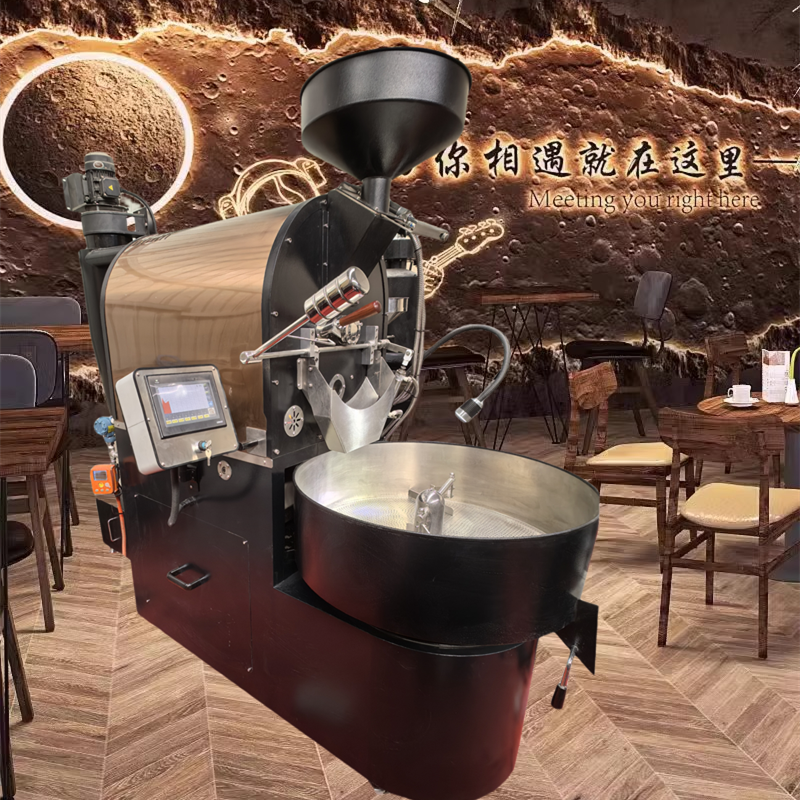
Safety Standards for Coffee Roasting Machines: A Comprehensive Guide
Electrical Safety Requirements
Grounding and Insulation
Coffee roasting machines must adhere to strict electrical safety protocols to prevent shock hazards. All models must feature double-layer insulation or reinforced grounding systems, particularly for components exposed to high temperatures. For example, heating elements and control panels must maintain a minimum insulation resistance of 2 megohms under operating conditions.
Overcurrent Protection
Machines must incorporate automatic circuit breakers or fuses rated for 125% of the maximum operational current. This ensures protection against short circuits or voltage surges, which are common in industrial settings with fluctuating power supplies.
Leakage Current Limits
To comply with international standards like IEC 60335, leakage current must not exceed 0.5 mA under normal operation and 3.5 mA in single-fault conditions. Regular testing using hipot testers is mandatory to verify compliance.
Mechanical Safety Design
Structural Integrity
Roasting chambers and exhaust ducts must withstand internal pressures up to 1.5 times the maximum operating pressure without deformation. This is critical for preventing explosions caused by blocked airflow or thermal expansion.
Hot Surface Protection
Exterior surfaces of the machine must remain below 60°C during operation to avoid burns. Manufacturers achieve this through heat-resistant materials like stainless steel 304 and thermal insulation layers.
Moving Parts Guards
Drum rotation mechanisms and cooling fans must be enclosed with interlocking guards that halt operation when opened. This prevents accidental contact with rotating components during maintenance.
Thermal Safety Controls
Temperature Monitoring Systems
Roasters require redundant temperature sensors placed at critical points:
- Bean inlet: Prevents overheating of raw beans
- Roasting chamber: Maintains optimal temperature profiles (typically 180–240°C)
- Exhaust duct: Monitors flue gas temperatures to detect combustion issues
Overheating Prevention
Automatic shutdown protocols must activate if temperatures exceed safety thresholds by 10% for more than 30 seconds. Some advanced models use PID controllers to adjust heat input dynamically.
Emergency Cooling
Industrial roasters must include forced-air cooling systems capable of reducing chamber temperature from 240°C to below 100°C within 15 minutes. This minimizes fire risks during abrupt stops.
Fire Prevention Measures
Ignition Source Control
Electrical components near roasting areas must be rated for Class II, Division 1 hazardous locations. This includes motors, switches, and wiring harnesses designed to prevent spark generation.
Combustible Dust Management
Chaff collection systems must achieve 99% efficiency in capturing airborne particles. Regular cleaning schedules and explosion-proof vacuum systems are required to prevent dust accumulation in ductwork.
Fire Suppression
Commercial roasters over 10 kg capacity must install automatic fire suppression systems using dry chemical or CO₂ agents. These systems must activate within 10 seconds of detecting flames.
Compliance Verification
Certification Requirements
- EU: CE marking under Machinery Directive 2006/42/EC and Low Voltage Directive 2014/35/EU
- US: UL 197 certification for commercial appliances and NFPA 86 compliance for fire safety
- Asia: CCC marking in China and PSE certification in Japan for electrical safety
Documentation
Manufacturers must provide:
- Risk assessment reports identifying potential hazards
- Maintenance manuals with detailed cleaning procedures
- Spare parts lists specifying compatible components
Third-Party Testing
Annual inspections by accredited laboratories (e.g., TÜV SÜD, SGS) are required to verify ongoing compliance. Testing includes pressure cycling tests, thermal shock resistance, and electrical safety audits.
By integrating these safety standards, coffee roasting machine operators can significantly reduce workplace accidents while ensuring consistent product quality. Regular training for maintenance personnel on hazard identification and emergency procedures remains equally critical for operational safety.