

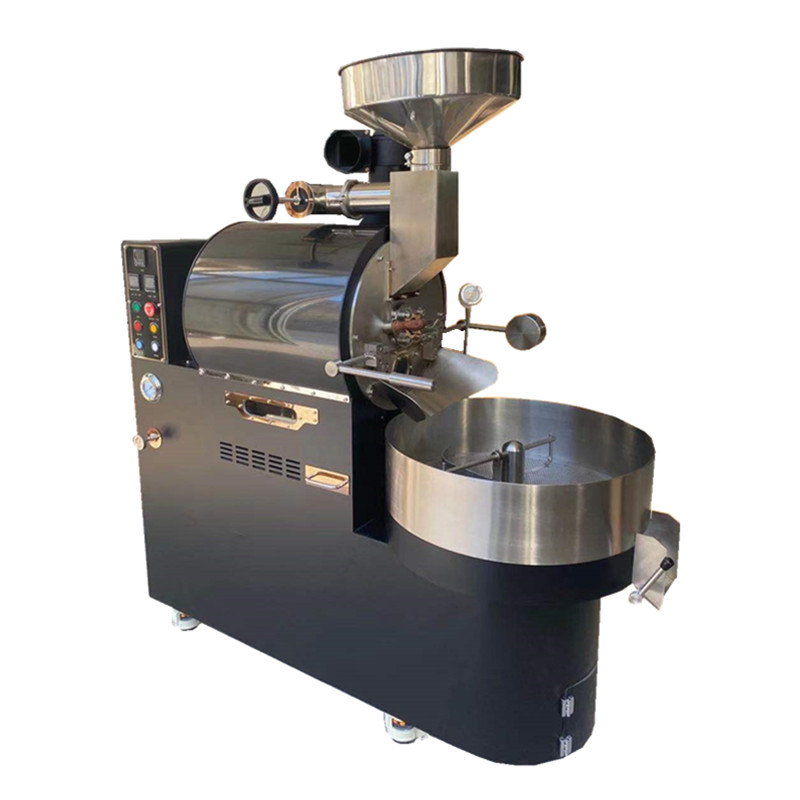
Choosing the Right Coffee Roaster Capacity: A Guide to Matching Scale and Quality
Understanding Batch Size Dynamics in Coffee Roasting
The capacity of a coffee roaster directly impacts flavor consistency, operational efficiency, and quality control. Small-batch roasters (under 1 kg) allow precise temperature adjustments during each roast, making them ideal for specialty beans requiring nuanced profiles. For example, a 500g batch of Geisha coffee from Panama benefits from frequent agitation and temperature tweaks that larger roasters cannot replicate.
Medium-capacity roasters (1–5 kg) strike a balance between control and volume. These machines suit cafés or small roasteries producing multiple single-origin offerings weekly. A 3 kg batch of Brazilian Santos beans can maintain even development when rotated manually every 90 seconds during the Maillard phase.
Large-capacity roasters (5+ kg) prioritize output over granular control. They excel for blends or commercial-grade beans where uniformity matters more than terroir-specific characteristics. A 10 kg batch of Colombian Supremo requires automated drum rotation and exhaust systems to prevent uneven roasting at the edges.
Matching Capacity to Production Needs
Daily output requirements should guide capacity selection. A café serving 100 espresso-based drinks daily needs approximately 2 kg of roasted coffee weekly. Opting for a 1 kg roaster running twice weekly preserves freshness while avoiding excess inventory. Conversely, a roastery supplying 10 cafés might need a 5 kg machine operating 4 days weekly to meet demand without overextending equipment.
Space constraints also play a role. Small-batch roasters occupy countertop or shelf space, making them viable for urban apartments or shared kitchen spaces. Medium and large roasters demand dedicated ventilation systems and floor space, often requiring professional installation. Measure available dimensions carefully—a 3 kg roaster typically needs 0.8m² of clearance around its exhaust duct.
Future growth projections should factor into decisions. A startup roaster planning to triple production within 18 months should consider a modular system. Some medium-capacity models allow adding secondary drums or upgrading control panels, extending usability without full equipment replacement.
Capacity’s Impact on Roast Consistency and Quality
Batch size affects thermal inertia—the time heat transfers through beans. Small batches (500g) reach target temperatures 20–30% faster than large batches (5kg), requiring quicker manual adjustments. This agility benefits delicate beans like Ethiopian Yirgacheffe, where overheating risks muting floral notes.
Airflow management becomes critical in larger roasters. A 5kg batch needs 15–20% more airflow than a 1kg batch to maintain even development. Insufficient airflow creates “chaff pockets” where silver skin accumulates, leading to scorched flavors. Proper ventilation systems prevent this by ensuring consistent exhaust throughout the drum.
Chaff collection efficiency varies by capacity. Small roasters often use removable trays requiring frequent emptying, while large models incorporate cyclonic separators that handle continuous operation. For medium roasters, consider dual-chamber chaff bins that reduce downtime between batches.
Practical Considerations for Capacity Selection
Energy consumption scales nonlinearly with capacity. A 1kg roaster uses roughly 0.5 kWh per batch, while a 5kg model consumes 1.8–2.2 kWh for the same duration. This disparity stems from larger drums requiring more preheating energy. Calculate long-term costs by estimating batches per week and local electricity rates.
Labor intensity differs across capacities. Small roasters demand 10–15 minutes of active monitoring per batch, including manual agitation and temperature checks. Medium roasters reduce hands-on time to 5–8 minutes with automated rotation, while large models often include programmable profiles that minimize operator input.
Storage requirements for green beans increase with capacity. A 5kg roaster operating weekly needs 20–25kg of green coffee inventory, requiring climate-controlled storage to prevent moisture fluctuations. Small roasters can manage with 5–10kg inventories stored in airtight containers at room temperature.
By evaluating production goals, spatial limitations, and quality priorities, roasters can select a capacity that optimizes both operational efficiency and cup quality. The ideal machine balances immediate needs with scalability, ensuring consistent results as demand evolves.